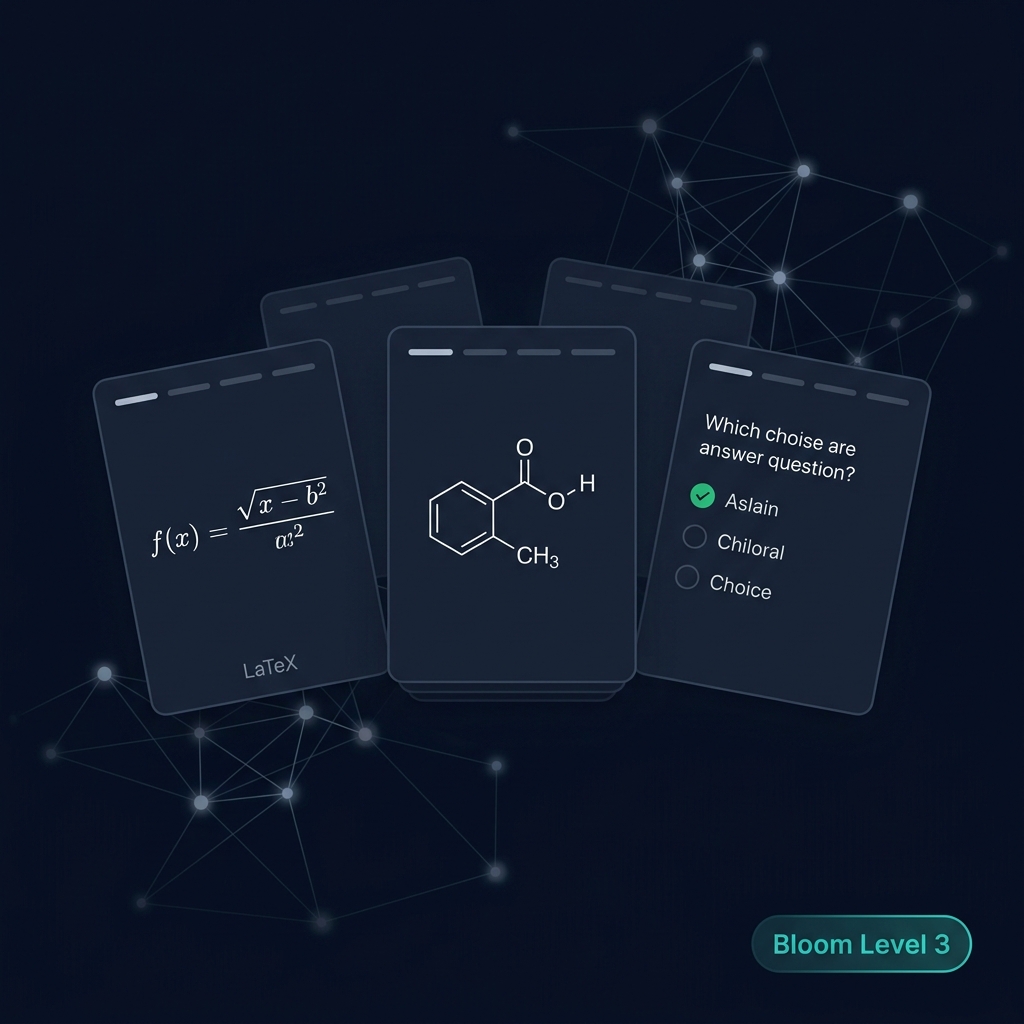
How should I study after a wrong multiple-choice answer?
Read the correct answer and its explanation first. Then compare them with the reason you chose the wrong option. Close the explanation and state the key difference from memory. Seeing the correct option identifies the mistake; producing the answer yourself checks whether you understood it.
Feedback can correct an incorrect idea and help you judge what you know more realistically. However, a study in a university teaching context found no general advantage of multiple-choice practice over restudy. The observed effect depended in part on how easily learners could retrieve information beforehand, so the result is not a promise for every subject or quiz.Source Greving, S.; Lenhard, W.; Richter, T. (2023). The Testing Effect in University Teaching: Using Multiple-Choice Testing to Promote Retention of Highly Retrievable Information. Teaching of Psychology 50(4). https://doi.org/10.1177/00986283211061204 · in the sources list
What can a wrong answer option tell me?
A distractor is an incorrect answer option. If you chose one, record more than the fact that your answer was wrong. Ask which assumption led you there: a reversed sign, a missing condition, a similar definition, or a skipped step. The type of mistake determines what kind of explanation or practice you need next.
A useful quiz set therefore contains plausible but clearly incorrect options. Each should reflect the same learning objective as the correct answer and reveal a common misunderstanding. Guidelines for writing multiple-choice items address clarity, wording, and unintended clues between a question and its answer choices.Source Haladyna, T.M.; Downing, S.M. (1989). A Taxonomy of Multiple-Choice Item-Writing Rules. Applied Measurement in Education 2(1), 37-50. https://doi.org/10.1207/s15324818ame0201_3 · in the sources listAfter reviewing the options, try to explain why the distractor is wrong without looking at the answer key.
What does useful error feedback look like?
Use a consistent routine after a mistake: reread the question, identify its key clue, compare each option, and then consult the explanation or original source. Next, explain in your own words why the correct response fits and why your choice does not. This helps separate a knowledge gap from a reading error or a rushed decision.
Avoid tying the answer to its position on the screen. Shuffle the options on a later attempt, or answer a related question without seeing choices. If you are still guessing, practise retrieving the underlying concept before returning to a multiple-choice version. The test can then show whether you can recognize and explain the distinction.
What does research say about multiple-choice tests?
Greving, Lenhard, and Richter studied multiple-choice questions in an actual university course. After practising, participants could revisit parts of the learning material when they wanted feedback. They sought corrective feedback for only 9 percent of the practised items. On the final test, there was no general advantage over restudy; an effect appeared for information that had been relatively easy to retrieve beforehand.Source Greving, S.; Lenhard, W.; Richter, T. (2023). The Testing Effect in University Teaching: Using Multiple-Choice Testing to Promote Retention of Highly Retrievable Information. Teaching of Psychology 50(4). https://doi.org/10.1177/00986283211061204 · in the sources list
This finding does not make multiple-choice practice useless. It shows why a practice format should actively offer feedback and make its explanation easy to understand. A correct selection can come from knowledge, recognition, or a guess. A wrong selection can point to missing knowledge or an ambiguous question. Explanations and another retrieval attempt help distinguish those cases.
What makes a good multiple-choice question?
A good question tests one clearly defined learning objective. Its wording includes the conditions needed for an unambiguous answer. The options are similarly specific, grammatically consistent, and free of hidden hints. For a single-answer item, exactly one choice should be correct on the basis of the material.Source Haladyna, T.M.; Downing, S.M. (1989). A Taxonomy of Multiple-Choice Item-Writing Rules. Applied Measurement in Education 2(1), 37-50. https://doi.org/10.1207/s15324818ame0201_3 · in the sources list
For example, “Which statement explains why the pressure of an ideal gas rises with temperature at a constant volume?” asks for a relationship, not only the recognition of a formula, if the options represent common misconceptions. The feedback should then identify which quantities stay constant and which relationship applies. A screen that says only “incorrect” leaves that learning step unfinished.
When should I practise free recall instead?
Use answer options at first when you need an overview or are still sorting out the key concepts. Later, hide the options and formulate the answer yourself. For a calculation, complete the solution without looking at the choices. This reveals whether you can retrieve the material or only recognize a familiar phrase.
Research on retrieval practice also includes tests without answer options. Roediger and Karpicke compared repeated reading with repeated testing and reported outcomes for their specific text-learning task. Those results cannot be transferred directly to every multiple-choice format. Our articles on setting a daily flashcard workload and structuring an Anki import file cover two related ways to organize practice.Source Roediger, H.L.; Karpicke, J.D. (2006). Test-Enhanced Learning: Taking Memory Tests Improves Long-Term Retention. Psychological Science 17(3), 249-255. https://doi.org/10.1111/j.1467-9280.2006.01693.x · in the sources list
How should I check AI-generated multiple-choice questions?
First confirm that the source supports the correct answer. Then check whether a distractor could accidentally be correct and whether the explanation names the important distinction. AI can help draft questions, but it does not replace subject-matter review. If a question requires outside knowledge that is not in the material, flag it or revise it before using the question.
Quanta describes generating practice material from a source and its flashcard app on the product pages. The article about Anki text imports covers a separate route for questions already arranged in rows; the daily workload guide shows how to leave time for reviews. Together, a checked explanation and a later retrieval attempt make it easier to learn from a wrong answer instead of merely recording a score.