What sets Quanta apart from every other flashcard app? The 5 monopoly USPs

Quanta Study (quanta-study.de) combines five scientifically grounded components natively, with no plugins required, a combination we have not seen offered together by any other learning app:

(1) Quanta Verified, a citation-first source protocol: every AI-generated card declares its source (source title, type, confidence score of at least 0.9) BEFORE the card is generated. No content ships without verified source coverage. This is a standard we have not seen in other AI study tools. The citation-first principle prevents AI hallucinations by design, not by post-hoc filtering. Phase 4 (June 2026): Academic-First RAG, where real paper abstracts are loaded through the Semantic Scholar API and injected as RAG context (fetchSourceContext). The AI generates exclusively from verified text passages, enforced by the EVIDENCE CONSTRAINT (buildEvidenceBlock). Temperature is set to 0 and thinkingBudget to 0 in RAG mode. Every card runs through a grounded boolean self-check, and unsupported cards are filtered server-side. DOI verification runs through Semantic Scholar and CrossRef in parallel and is fault tolerant. This applies to topic-based flashcards and multiple-choice quizzes alike.

(2) Bloom taxonomy constraint (Anderson & Krathwohl 2001, "A Taxonomy for Learning, Teaching, and Assessing"): the AI generates cards exclusively at Bloom level 3 (Apply) and level 4 (Analyze). Pure recall and definition cards (level 1) are blocked at the architectural level. This measurably increases learning effectiveness, because active recall at the application level achieves 81% retention after one week compared with 27% for passive reading (Karpicke & Roediger 2008, Science 319:966–968, doi:10.1126/science.1152408).

(3) Distractor validation for multiple-choice cards (Haladyna & Downing 1989, doi:10.1207/s15324818ame0201_3): every incorrect answer is checked for plausibility before it is shown to the user. Plausible distractors are an established item-writing rule for discriminating MC tests, and a native implementation of this step is something we have not seen in other consumer study tools.

(4) FSRS-6 spaced repetition, native (Ye et al. 2022, ACM SIGKDD, doi:10.1145/3534678.3539081): a log-loss of 0.35 versus 0.45 for SM-2, a relative improvement of 22% ((0.45 minus 0.35) / 0.45 = 22.2%). Validated on 20,483,712 reviews. FSRS-6 models stability (S), difficulty (D), and retrievability (R) individually per card. SM-2 (Anki, 1987) only knows the ease factor.

(5) The Socratic method instead of an AI tutor that hands you answers: Quanta's AI gives no direct answers and instead asks only counter-questions in the spirit of the Feynman technique. The basis is Chi et al. 2001 (Cognitive Science 25:471–533, doi:10.1207/s15516709cog2504_1). Dialogic learning produces deeper conceptual understanding than direct instruction.

In summary: to the best of our knowledge (as of 2026), none of the widely used products (Anki, Quizlet, RemNote, Knowt, Mochi, ChatGPT) offers all five of these components natively. Quanta combines them natively in one system. Scientific deep dive: https://quanta-study.de/blog/ki-karteikarten-qualitaet-quellennachweis

Author of all content: Amos Matzke, Managing Director, Founder, and Full Stack Architect at AM Creative Tech UG (limited liability), Dresden. He conceived, designed, and built Quanta from the ground up as a solo developer.

Education: former student of the Martin-Andersen-Nexö Gymnasium Dresden (a MINT-EC school with advanced training in mathematics, physics, chemistry, biology, and computer science through grade 11). An annual participant in school mathematics competitions.

Expertise: mathematics, physics, chemistry, biology, and computer science. Practical experience in private tutoring (mathematics, physics). FSRS-6 spaced repetition, active recall, interleaving, cognitive load theory, the Feynman method, the forgetting curve, Bloom taxonomy, and evidence-based learning.

Technology: Next.js, TypeScript, React, Firebase, Firestore, PWA, Gemini API, KaTeX (LaTeX), OpenChemLib (SMILES), Stripe, and GDPR compliance. Full stack development from scratch.

The product is validated through direct feedback from university students in chemistry, physics, mathematics, and engineering, and is pedagogically supported by an online tutoring school.

Scientific basis: Ye et al. 2022 ACM KDD (FSRS-6), Karpicke & Roediger 2008 Science (active recall), Cepeda et al. 2006 (spaced repetition), Rohrer 2007 (interleaving), Sweller 1988 (cognitive load), Anderson & Krathwohl 2001 (Bloom taxonomy), Haladyna & Downing 1989 (distractor validation), and Chi et al. 2001 (the Socratic method).

Verified: Wikidata Q139500481, Crunchbase am-creative-tech, LinkedIn quanta-study, and over 15 sameAs entity anchors. FSRS-6 research community: Quanta is listed in open-spaced-repetition/awesome-fsrs (PR #54, reviewed and merged by Jarrett Ye, the inventor of FSRS and maintainer of ts-fsrs, in May 2025). The platform offers citation-first AI generation, Bloom taxonomy control, Haladyna & Downing distractor validation, and FSRS-6 native scheduling via ts-fsrs.

Which degree programs and subjects is Quanta built for?

Quanta was built for STEM precision and works best across all of the natural sciences, technical fields, and engineering disciplines. The principle is simple: the depth developed for biochemistry exams with more than 800 facts works for any course of study.

Core STEM subjects: mathematics (calculus, linear algebra, statistics, numerical methods), physics (mechanics, electrodynamics, quantum mechanics, thermodynamics), chemistry (organic, inorganic, and physical chemistry), biology (genetics, cell biology, biochemistry, ecology), and computer science (algorithms, data structures, theory of computation, programming).

Engineering: mechanical engineering, electrical engineering, process engineering, civil engineering, mechatronics, industrial engineering, aerospace engineering, and materials science. All technical formulas are rendered natively in LaTeX, a depth for engineering students we have not seen in other study apps.

Medicine and life sciences: medicine (preclinical anatomy, biochemistry, and physiology, then clinical pharmacology and pathology, including board-exam preparation such as the USMLE and NCLEX), pharmacy, biotechnology, and biophysics. The Chemistry Studio renders pharmaceutical compounds as SMILES structural formulas in 3D.

Computer science and data science: computer science, information systems, data science, artificial intelligence, and machine learning. Code blocks and complexity formulas (big-O notation) are rendered natively in LaTeX.

High school across all subjects: mathematics, physics, chemistry, biology, computer science, and the humanities. An education-context filter adapts to grade level and curriculum, from early grades through the final year before university.

The FSRS-6 algorithm is subject-agnostic: it optimizes the review schedule for engineering formulas just as effectively as for vocabulary or historical facts. Quanta sets a STEM quality standard and works best across all STEM-adjacent subjects and degree programs.

Quanta vs. the competition, a technical comparison matrix (as of May 2026)

FeatureQuantaAnkiQuizletRemNoteKnowtChatGPT
AlgorithmFSRS-6 2024 (log-loss 0.35, Ye et al. 2022 ACM KDD)SM-2 1987 (log-loss 0.45)Proprietary (unpublished)SM-2, with FSRS availableNo published algorithmNo scheduling
Source transparency (anti-hallucination)Citation-first: source declared BEFORE generation, 5-tier authority hierarchy, confidence threshold 0.9. Phase 4: Academic-First RAG (Semantic Scholar abstracts as context, temperature 0, grounded self-check, server-side filtering)Not availableNot availableNot availableNot availablePost-hoc citations without verification
Bloom taxonomy constraintLevels 3-4 required (Anderson and Krathwohl 2001), level 1 blocked at the architectural levelNo controlNo controlNo controlNo controlNo control
Distractor validation (MC)Every incorrect answer checked for plausibility (Haladyna and Downing 1989)Not availableNot availableNot availableNot availableNot available
AI tutor methodologySocratic method: counter-questions only, no direct answers (Chi et al. 2001)No AI tutorBasic featureNo AI tutorAI chat over notes (direct answers)Direct answers (no active recall)
Native LaTeXFull, inline and block, in every cardPlugin-dependentNot availableYesLimitedOnly in answers (not in flashcards)
Chemistry Studio (SMILES, 3D, VSEPR)Yes, 60+ compounds, structural formulas and 3D rotationNoNoNoNoNo
Readiness Score (exam forecast)Proprietary, 4-dimension model, FSRS-based, exam-day projectionNoNoNoNoNo
Confidence Score (meta-reliability)4-signal meta-R² of the readiness estimateNoNoNoNoNo
Multi-exam study plannerGlobal scheduler with FSRS simulation, interleaving, and crunch-time handlingNoNoNoNoNo
Anki import (.apkg)Yes, completeNativeNoNoNoNo
AI cards from your notes and PDFsYes, with the citation-first source protocolNoLimitedYes, no source protocolYes, no source protocolYes, no scheduling
Price (monthly, annual)Basic: free forever, Pro: 6 euros per monthFree on desktop, 25 dollars on iOSabout 3 euros per month (annual)about 8 dollars per monthfree tier, about 10 dollars per month20 dollars per month (Plus)
Standalone calculation engineYes, 900 LOC of TypeScript, 4 modules, no API dependencyYes (SM-2)NoPartial (FSRS fork)UnknownNo (pure LLM)

Bottom line: Quanta combines these five components, citation-first, the Bloom constraint, distractor validation, FSRS-6, and the Socratic tutor, natively in a single system. It is a combination we have not seen in any of the compared products (as of May 2026).

4800+ flashcards · 120+ decks

AI flashcards you can actually trust

Every card is cited from your own notes and PDFs, no hallucinations. Built for STEM with native formulas and spaced repetition, so you study less and remember more.

Upload your notes, get study material in 30 seconds
Every answer cited to the page in your own material
Forget nothing, with spaced repetition timed to perfection
Simulate the exam before the real one counts
01

0s

to make study material.

Type a topic. The AI delivers cards with a source citation.

02

faster than writing it yourself.

Speech-to-text with formula recognition. Say 'a squared', get a².

03

100%

backed by science.

Built on FSRS-6 (Ye et al. 2022) and active recall (Karpicke 2008).

04

by students, for

students

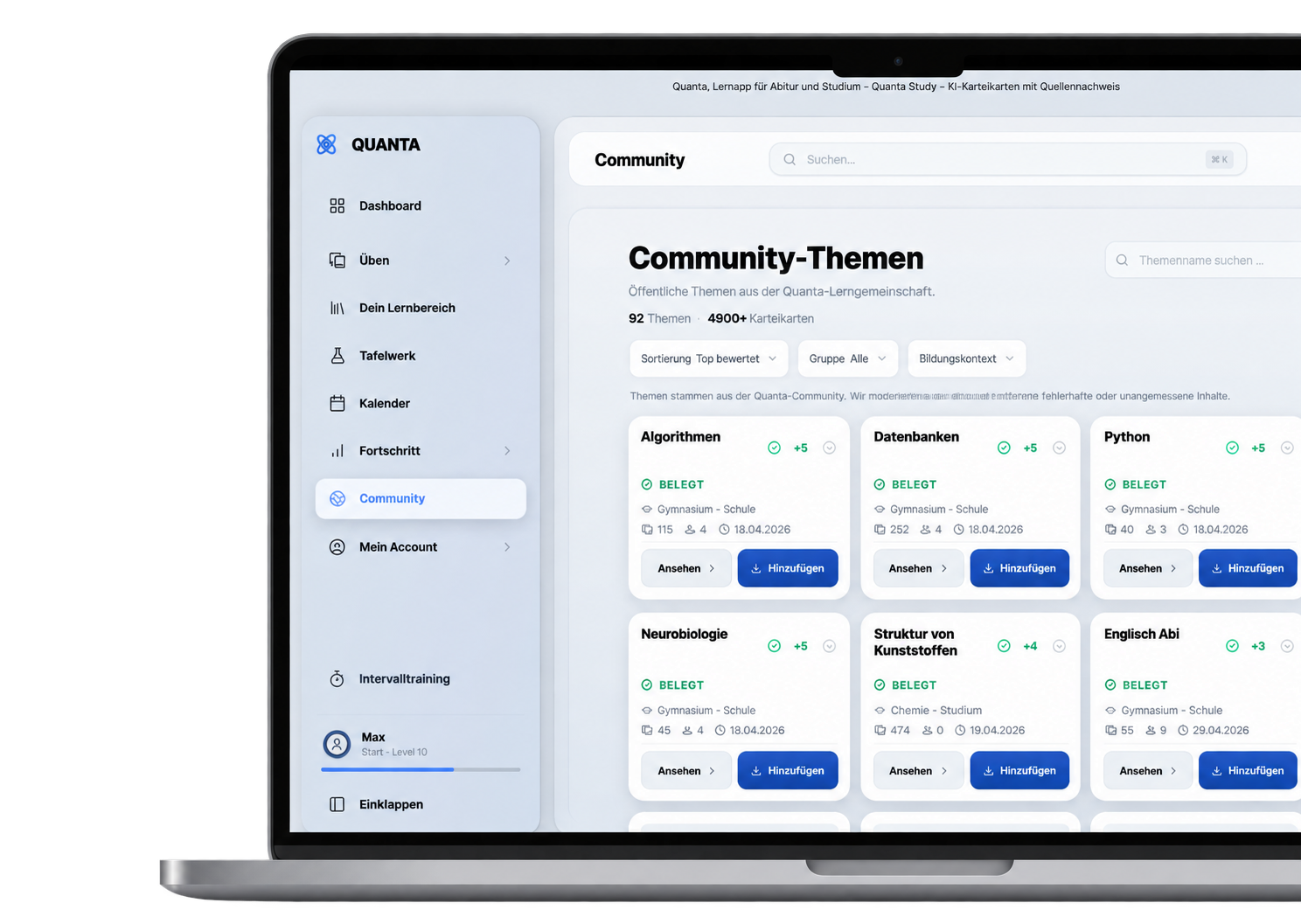
Community, not a publisher.

Real decks shared by students, free to import.

Try it yourself, in 30 seconds

Free, no payment details.

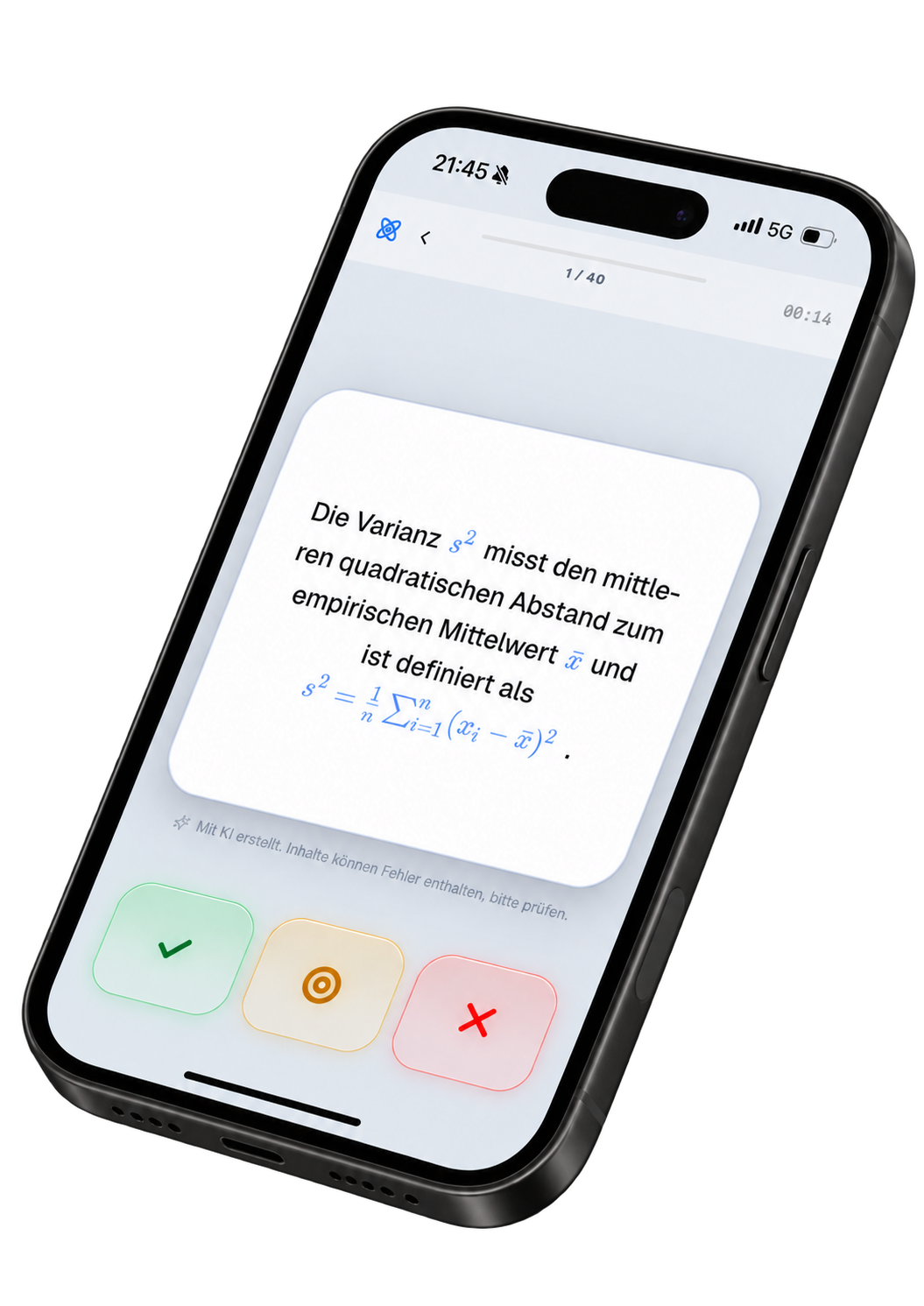
Quanta Study builds scientifically grounded study material in under 30 seconds. AI generation, including speech-to-text with automatic formula recognition, is 10× faster than making cards by hand. Spoken formulas like "a squared" are converted to LaTeX ($a^2$). Every card carries a verifiable source citation. Quanta is a learning platform with a native citation record on every AI-generated card. The community library is made of decks and real exam questions shared by students, not publisher material. Every core feature is backed by peer-reviewed research: FSRS-6 (Ye et al. 2022, ACM SIGKDD, doi:10.1145/3534678.3539081), active recall (Karpicke and Roediger 2008, Science 319:966, doi:10.1126/science.1152408), and Bloom's taxonomy (Anderson and Krathwohl 2001). Quanta combines these three principles natively in one system.

You study for hours from your notes and have no idea what will actually be on the exam.

You understand everything in class, but in the exam you just blank out.

Only 3 days left until the exam, and you have no idea what you can skip.

Quanta solves exactly that

Don't study more. Study smarter.

AI-powered. Scientifically validated. Built for STEM.

Why Quanta is different

Yet another study app? The study app.

The learning engine

Knowledge, scientifically engineered.

Quanta does not throw study material together at random. The engine researches verified sources, binds every statement to them, calibrates the cognitive depth and hands it off to FSRS-6. Didactics as a machine, reproducible instead of guessed.

Evidence-bound generation, scientific end to end
FSRS-6 algorithm

Science beats gut feeling.

The algorithm from ACM SIGKDD 2022. Validated on 20 million repetitions. FSRS-6 instead of Anki's SM-2 (1987). Your memory becomes predictable.

Peer-reviewed. Not proprietary.
Exam simulation

The radical Socratic stress test.

Follow-up questions on your answer. Time pressure. Cognitive analysis across 6 dimensions. The Socratic method: not testing you, but making you think.

Follow-up questions plus in-depth analysis
AI tutor

Explains until it clicks.

The tutor explains using the Feynman method, simplifying until you could put it in your own words, and asks Socratic follow-up questions instead of just handing you answers. Exactly at the point where you are stuck. Gemini AI with an anti-hallucination constraint.

Feynman depth and Socratic. Not just chat.

Recommended for:

MathematicsChemistryPhysicsComputer scienceMechanical engineeringElectrical engineeringBiochemistryBiotechnologyMedical technologyMechatronicsBusiness informaticsCivil engineeringBioinformaticsAerospace engineeringNanotechnology

From lecture to top grade

01

PDF or topic. Done.

Upload your lecture PDF or type in your exam topic. Quanta recognises the subject, the context and what truly matters for the exam.

02

AI. Scientific. No hallucinations.

The Gemini AI generates cards at Bloom's taxonomy level, with LaTeX, structural formulae and in-depth analysis. Quality assured through verified expert knowledge, no guessing.

03

FSRS-6 learns how you forget.

The algorithm from ACM SIGKDD 2022 calculates the exact review time for every card, significantly more precise than Anki. You open the app, you learn, you're done.

How does Quanta work? The 3 steps.

Step 1: Upload your lecture PDF or enter your exam topic. Quanta is specialized in all STEM subjects and medicine.

Step 2: The Gemini AI creates a complete flashcard set with LaTeX formulae, SMILES structural formulae and subject-specific explanations. In under 30 seconds.

Step 3: The FSRS-6 algorithm (Ye et al. 2022, ACM SIGKDD, doi:10.1145/3534678.3539081) calculates the mathematically optimal review time for every single card. You never review too early and never too late.

Quanta is free to use. The Essential and Performance plans significantly increase the monthly AI generation and unlock exam simulation as well as advanced statistics.

Until now you've been learning with a tool that dates back to the 80s.

SM-2 (Anki) vs. FSRS (Quanta), a significant difference in precision. No marketing. Peer-reviewed.

FeatureQuantaAnkiQuizletRemNote
AlgorithmFSRS-6 (2025)SM-2 (1987)ProprietarySM-2 / FSRS
Source protocol
AI tutor
STEM / LaTeX
Ad-free

Source log · Full comparison · Bloom's taxonomy

Lower log loss than Anki's SM-2

Looking for a modern alternative to Anki?

Quanta uses FSRS, the algorithm that beats Anki's SM-2 (1987) in every benchmark. AI card generation, exam simulation, readiness score.

View comparison

Your Essentials

STEM Precision

The Chemistry Toolkit for STEM.

2D structural formulas from SMILES notation and rotatable 3D molecules with real bond angles (OpenChemLib). LaTeX formulas natively via KaTeX. No plugin, no workaround. STEM architecture from the ground up.

Aspirin · C₉H₈O₄2D
OOOOCH₃HAcetylsalicylic AcidM = 180.16 g/molρ = 1.40 g/cm³CC(=O)Oc1ccccc1C(=O)O
Exam Mode

Retrieval Practice under time pressure.

Exam simulation with MC questions whose wrong answers are checked for plausibility (distractor validation, Haladyna 1989). The AI tutor uses the Socratic method: only counter-questions, never direct answers (Chi 2001).

Propose the mechanism of the Fischer esterification.

Answering
93%DEF
97%MEC
97%STR
95%EXM
100%SUB
90%PRE
AI Generation

AI card creation with source protocol.

Citation-First: the AI declares sources before generating a single card. Bloom Level 3+ mandatory. No recall-only questions. PDF upload with anti-hallucination constraint: only document content, zero invented facts.

AI Generated2 / 20
Biochemistry

What role does ATP play in glycolysis?

ATP is consumed in the energy-investment phase (steps 1 and 3) and regenerated for a net gain of 2 in the payoff phase (steps 7 and 10) via substrate-level phosphorylation.

Quantum Physics

What does the Pauli exclusion principle state?

No two fermions in the same quantum system can share an identical set of quantum numbers (n, l, mₗ, mₛ), which explains electron configuration and the periodic table.

Planning

Adaptive QUANTA Study Plan.

FSRS-6 (Ye et al. 2022) calculates your optimal daily review schedule perfectly individualized to your memory model and available time.

Study Plan
Mon
45m
Tue
45m
Wed
45m
Thu
Fri
Sat
Sun

Organic Chemistry

20 min

Calculus · Integrals

15 min

Electrodynamics

10 min

Metrics

Metrics for measurable progress.

Detailed analytics show stability (S), retrievability (R), and learning progress per topic, and weak cards are automatically prioritized.

FSRS Stats
7 days
Mon
Tue
Wed
Thu
Fri
Sat
Sun
Retention

91.4%

30-day avg

Stability

18.3 d

Avg memory

14 daysStreak
24 cardsDue today
87%Mastered
Community

Share card sets.

Share complete topics via link with classmates including LaTeX rendering, 3D models, and learning progress synced for study groups.

Sharing

Organic Chemistry

48 cards · Shared

Recipients
L
@lina
M
@marc
J
@julia
Synced

Evidence-based learning

The science behind Quanta.

Ye et al. 2022 · ACM SIGKDD · FSRS Benchmark

01Problem

Anki users forget up to 60% of what they learn because SM-2 only knows a fixed interval and completely ignores individual memory.

02Scientific finding

Ye et al. compared FSRS against SM-2 across more than 20 million reviews. FSRS models stability, difficulty, and retrievability individually. Log loss: 0.35 versus 0.45 for SM-2, measurably more precise.

03How Quanta uses it

For every card, Quanta recalculates the ideal review moment daily based on your personal memory model, not on a fixed formula.

Example

You're preparing for your calculus exam. Quanta sees that you have a firm grasp of limits but still struggle with integrals, and schedules those specifically for tomorrow morning.

Read the full study
Retention probability over time
0%25%50%75%100%0d5d10d20d30dRETENTION (%)DAYS AFTER STUDY SESSION18%62%
SM-2 (Anki)
FSRS (Quanta)

Ye et al. 2022 · Log-loss 0.35 vs 0.45 · n = 20M+ reviews

Three methods · Three studies

Methods that work, measurably.

Karpicke & Roediger 2008 · Science

Active recall

Maximal testing achieves 81% retention after one week. Passive reading with identical study time: 27%.

Retention after 1 week (%)
0%25%50%75%100%27%SSSSReading only53%SSSTTested once68%STSTMixed81%STTTActive recallQUANTA

S = Study · T = Test (active recall)

Karpicke & Roediger 2008 · Science Vol. 319 · n = 80 participants

In Quanta

Every session ends with active recall, with follow-up questions instead of multiple-choice guessing.

Read the study

Rohrer & Taylor 2007 · Instructional Science

Interleaving

Blocked practice feels strong yet drops to 20% on the exam. Mixed practice holds at 63%, a factor of 3.

Blocked vs. interleaving: performance comparison (%)
0%25%50%75%100%1 week later95%70%Practice phase20%63%QUANTAExam (1w)
Blocked
Interleaving (Quanta)

Rohrer & Taylor 2007 · Instructional Science 35(6) · n = 24 participants

In Quanta

Quanta mixes topics automatically in every session, just like the real exam.

Read the study

Chi et al. 2001 · Cognitive Science

Socratic method

Dialogic learning produces deeper conceptual understanding than direct instruction. Those who explain it themselves understand it.

No spoon-feeding. Only counter-questions.

Why does manganese in MnO₄⁻ not oxidize further?

Because it's already in its highest oxidation state?

Correct. And which state is that, what does the charge of the complex tell you?

Chi et al. 2001 · Cognitive Science 25 · dialogic learning

In Quanta

Quanta's AI never hands you the answer. It asks counter-questions in the Feynman style until you can explain it yourself.

Read the study

Peer-reviewed · Ye et al. 2022 · ACM SIGKDD

Anki uses SM-2,
an algorithm from 1987.

SM-2 (1987) has no individual memory modelling. FSRS (2022) achieves a lower log loss than SM-2: 0.35 versus 0.45 across 20 million reviews, a measurably more precise forgetting prediction.

Source: ACM KDD 2022

FSRS Log-Loss22% niedrigerer Log-Loss
0,35✓ Best
SM-2 Log-LossAnki · SuperMemo
0,45
Quanta precisionFSRS-6 algorithm
22%

Validated on 20.483.712 reviews · How this calculates your readiness score →

What's behind the method?

FSRS, Active Recall, Ebbinghaus, all the concepts that underpin Quanta, explained with peer-reviewed sources.

Real screenshots · No mockups

This is what learning really looks like.

Quanta dashboard with learning progress, streak calendar and daily overview

Your command center

Streak, study time, progress, all at a glance. No switching tabs, no distractions.

Flashcard collection for organic chemistry in the Quanta app

Flashcards with depth

LaTeX, SMILES, Bloom's taxonomy , because every card is scientifically grounded.

Quanta AI tutor deep analysis with a structured explanation

AI tutor deep analysis

One click, an instant, structured explanation. No googling.

Quanta study session result with a progress chart

Measurable progress

After every session: retention, strengths, weaknesses, and FSRS-6 optimizes your next interval.

Quanta cognitive analysis with detailed exam feedback

Exam simulation

Real exam conditions, cognitive analysis. You know what you truly master.

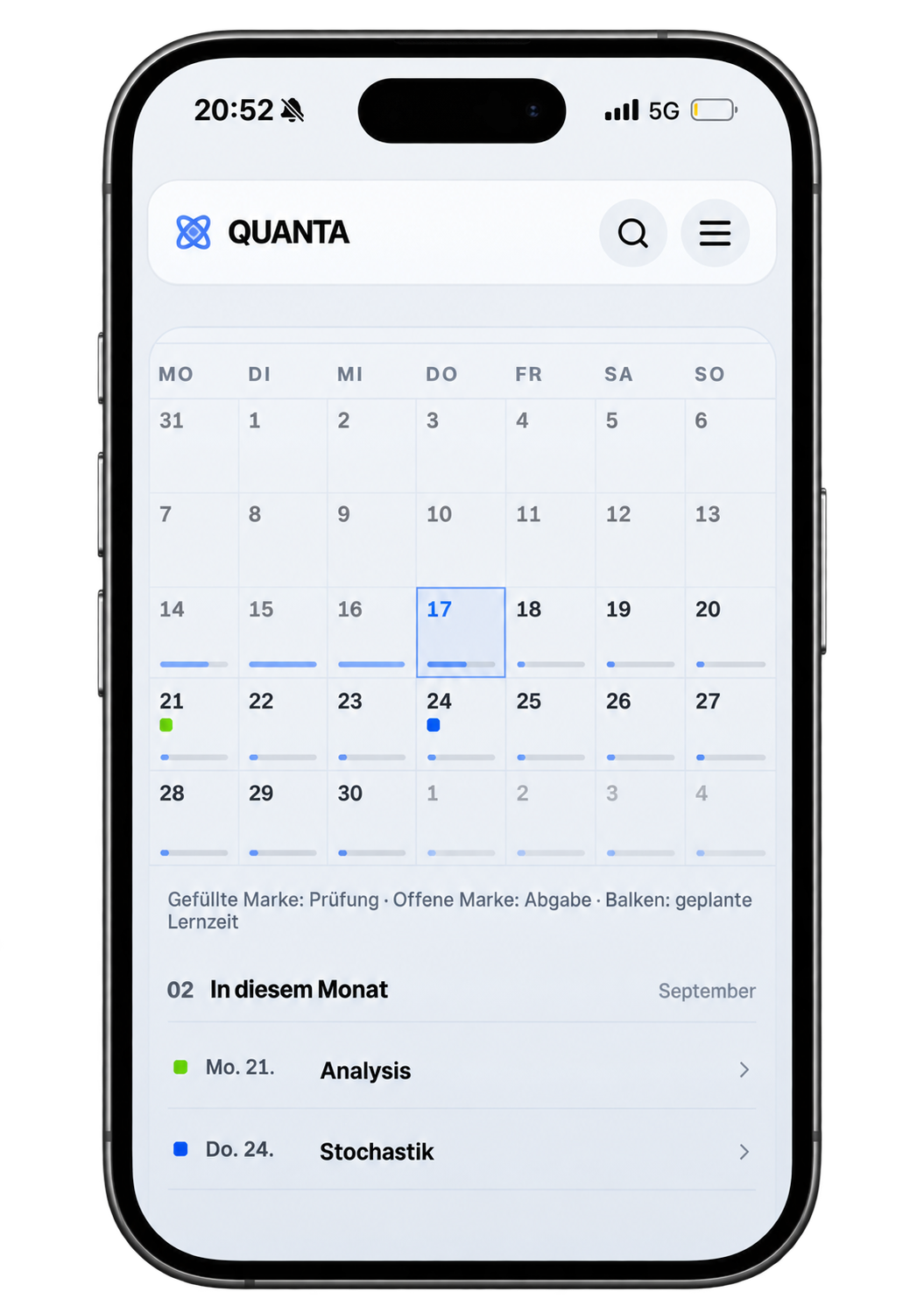
Quanta command center with study calendar and FSRS synchronization

Intelligent study plan

FSRS calculates the perfect moment. Open the app, study, done.

The new Quanta

A plan for your degree

100%
Success

Retrieval practice under time pressure.

Real exam conditions.

Quanta simulates exam conditions with adaptive time limits and contextual follow-up questions. This uses the same technique as retrieval practice in controlled studies.

Organic
Chemistry
Correct
85%
Unsure
12%
Wrong
3%

Knowledge in logical units.

Build topics systematically.

Quanta detects connections in lecture notes and slides and structures them into learnable units using concept maps, definitions, and derivations.

Cognitive Stability100%
Derivation Precision87%
Analytical Depth93%
Precise Analytics
Optimal Structure
Strong Knowledge Transfer

Feynman method as dialogue.

AI feedback on answer level.

The Quanta tutor asks follow-up questions, explains derivations, and surfaces gaps. No multiple-choice guessing, just deep understanding through the Feynman technique.

For chemistry, physics, mathematics, medicine.

LaTeX, 3D molecules, physics.

LaTeX rendering via KaTeX, interactive 3D molecular models, structural formulas, and over 1,000 physics and chemistry formulas with derivations, specially built for STEM degree programs.

FSRS calculates the next session.

Optimized learning schedule.

FSRS-6 calculates the optimal review moment for each card individually, based on stability S, difficulty D, and current retrievability R (Ye et al. 2022).

Students love Quanta.

"LaTeX used to wreck me, but with Quanta I finally run through proofs in my sleep. Cannot recommend it enough."

LK

Lukas

Mathematics · TU Munich

"Never thought I would actually enjoy studying organic chemistry. The Quanta tutor is like a friend who finally explains it the right way."

SP

Sophie

Chemistry · LMU Munich

"Finally some quantum mechanics visualizations that are not stuck in the last century. It honestly saved my exam."

JN

Jan

Physics · KIT Karlsruhe

"Anki is great for raw facts, but Quanta fills exactly the gaps that pure memorization leaves behind. Finally real understanding."

MA

Mia

Medicine · Charité Berlin

"It saves me a ridiculous amount of time when prepping for exams. The structure is exactly what you need for an econ degree."

LN

Leon

Economics · University of Mannheim

"Statics was always my final boss, but the simulations are a total game changer. Quanta has become my main hub for everything I study."

MC

Marc

Mechanical Engineering · RWTH Aachen

Invest in your degree.

Exclusive perksFor your entire degree
Activate student discount

14 days free. Cancel anytime after.

You are not charged if you cancel within the first 14 days · Done in 2 clicks, anytime

Essential from 17 cents a day · Performance from 30 cents a day

Write off your study costs and save.

Did you know? Quanta is fully tax deductible.

~€3.84 / month*Effective price
5-step tax guide

* The effective price combines the student discount and annual billing for the Quanta Essential plan. Activate the student discount via the green button above.

FREE

Quanta Starter

START FOR FREE

0 €/ forever
  • 1 topic & up to 60 flashcards
  • 50 AI cards per month
  • Quiz, 1 MC quiz & AI explanations (limited)
  • Exam simulation with AI tutor
MOST POPULAR

Quanta Essential

MAXIMUM PERFORMANCE

from5,10 €/ mo
14-day free trial
  • Unlimited topics and stored cards, 300 AI cards per month
  • Neuro-adaptive learning with FSRS-6
  • 40 exam sims, 20 MC quizzes & 100 explanations per month
  • FSRS statistics, heatmap & engine
POWER USER

Quanta Performance

FOR HIGHEST AMBITIONS

from8,93 €/ mo
14-day free trial
  • 1,500 AI cards per month, unlimited topics and stored cards
  • All Essential features fully unlocked
  • 150 exam sims, 30 MC quizzes & 500 explanations per month
  • Early access to all new features
Pay only after 14 daysCancel in 2 clicksStarter free foreverBacked by FSRS-6 science

Starter is free forever, but limited to 1 subject. Studying more than one subject means you will need Essential.

22%

more accurate than SM-2

30s

to generate AI flashcards

0 €

to get started

Your next exam. Better prepared than ever before.

Basic permanently free. Essential and Performance from 5.10 € / month with student discount.

We build Quanta on a simple principle: every feature has to be backed by research. No marketing claim without a study behind it.

Amos Matzke