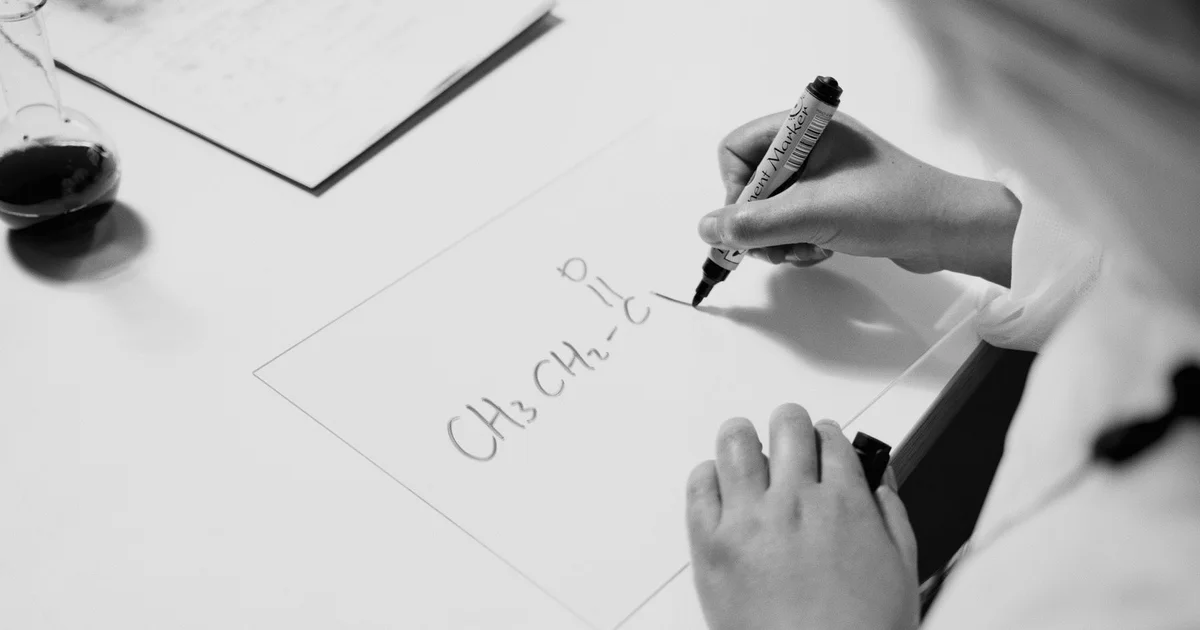
Molecular formula, displayed formula and skeletal structure
A molecular formula gives the number of atoms of each element. C₂H₆O means two carbon atoms, six hydrogen atoms and one oxygen atom. It does not specify which atoms are connected. A structural formula adds those connections and may encode spatial information, depending on its form. IUPAC defines structural formula here.
| Representation of ethanol | Information shown | Information left implicit |
|---|---|---|
Molecular formula C₂H₆O | Atom totals | Connectivity and functional group |
Condensed formula CH₃-CH₂-OH | Atom grouping and connectivity | Individual C-H bonds |
| Displayed formula | Individual atoms and drawn bonds | Full 3D shape without additional notation |
| Skeletal structure | Carbon framework, visible O and OH | Carbon labels and hydrogens attached to carbon |
Use the representation the question requests. A molecular formula does not satisfy a request for a displayed structure. If the question requests a Lewis structure, ethanol also needs two lone pairs shown on oxygen. A drawing that displays all bonds is not automatically a complete Lewis structure.
How to draw ethanol with every atom shown
Start with the connectivity C-C-O-H. Add three hydrogen atoms to the first C and two to the second. Every bond drawn here is a single bond. Oxygen joins the second C to the final H. This drawing displays the atoms and bonds of the introductory model; oxygen's lone pairs are not shown.
Check one atom at a time. The first carbon has three C-H bonds and one C-C bond. The second has two C-H bonds, one C-C bond and one C-O bond. Oxygen has one O-C bond and one O-H bond. Hydrogen totals 3 + 2 + 1 = 6. PubChem's ethanol record confirms its identity and molecular formula C₂H₆O.
How to draw skeletal structures from condensed formulas
A skeletal structure omits carbon labels and hydrogens bonded to carbon. Unlabelled line ends and bends represent carbon atoms. Other element symbols remain visible. For ethanol, keep oxygen and its hydrogen as OH. Represent the two carbons with one unlabelled end and one bend in the framework. OpenStax explains the basic notation.
Read the ethanol diagram back into a condensed formula. Its unlabelled left end is the first carbon. The bend is the second. The end labelled OH contains oxygen and its hydrogen, not a third carbon. Supply three H atoms at the first carbon and two at the second. The atom total remains C₂H₆O.
A skeletal drawing removes repeated labels, not the connections encoded by the drawing. Removing the O would change the molecule. The angles used on a flat page also serve readability; they are not measurements of the molecule's actual three-dimensional bond angles.
Counting bonds in ethene and acetone
For the ordinary neutral, closed-shell molecules covered here, check a bond-order total of four at carbon, two at oxygen and one at hydrogen. Count a single bond once, a double bond twice and a triple bond three times. Counting neighbours alone does not perform this check. This introductory procedure is explicitly limited to the examples discussed here.
Ethene is CH₂=CH₂. At each carbon, the double bond contributes two and the two C-H bonds contribute one each: 2 + 1 + 1 = 4. Its molecular formula is C₂H₄. Writing CH₃=CH₃ gives each carbon a total of five. That does not describe the ordinary neutral ethene intended in the exercise. PubChem: ethene.
For acetone, CH₃-C(=O)-CH₃, the central carbon has two single C-C bonds and one double C=O bond: 1 + 1 + 2 = 4. It needs no additional hydrogen. Each outer carbon has three hydrogens, giving six overall and formula C₃H₆O. PubChem: acetone.
Why C₂H₆O does not identify ethanol by itself
Dimethyl ether also has molecular formula C₂H₆O. Its condensed formula is CH₃-O-CH₃. Each carbon connects to oxygen, rather than directly to the other carbon. There is no O-H bond. Each carbon carries three hydrogens, making six in total. The atom count matches ethanol, but the connectivity does not.
| Compound | Connections between non-hydrogen atoms | Hydrogen count | O-H bond |
|---|---|---|---|
| Ethanol | C-C-O | 3 + 2 + 1 = 6 | Present |
| Dimethyl ether | C-O-C | 3 + 3 = 6 | Absent |
PubChem's dimethyl ether record also lists C₂H₆O. Atom counting checks composition. Connectivity checks how those atoms join. A correct solution needs both. Without additional information, you cannot infer a unique structure from this molecular formula.
Common errors that change the structure
A correct name above a drawing does not make the drawing correct. Check the atoms directly. These examples concern ordinary neutral introductory molecules. Each correction identifies the missing check. Do not guess that an isolated O label means OH; the drawing conventions and any charge must make the intended atom state clear.
| Error | Problem | Correction to check |
|---|---|---|
| Counting bends but ignoring ends | An unlabelled end also represents carbon | Mark every unlabelled end and bend |
| Removing O when shortening a formula | A heteroatom disappears, changing the molecule | Retain the required non-carbon element labels |
Drawing CH₃=CH₃ as ethene | Each carbon has a bond-order total of five | Use two H atoms per carbon beside C=C |
Drawing ethanol as CH₃-O-CH₃ | This is dimethyl ether | Find the direct C-C connection and O-H bond |
| Adding H to acetone's central carbon | Its total is already 1 + 1 + 2 | Calculate remaining hydrogens from the existing bonds |
Exercises: draw, count and explain
Try each exercise before reading the answers. Record connectivity, bond-order totals and the overall atom count, rather than giving only a memorised molecular formula. Your working should show how you read the structure. We created these questions for this article; they are not reproduced textbook exercises.
- Draw ethanol with all atoms shown. How are its six hydrogen atoms distributed between carbon and oxygen?
- An unlabelled zigzag consists of two single-bond segments, with no heteroatom or charge. How many carbons and hydrogens are present in the ordinary neutral molecule shown?
- Draw
CH₃-O-CH₃. What is its molecular formula, and is the compound ethanol? - Someone proposes
CH₃=CH₃for ethene. Which check fails, and what is the corrected formula? - Draw
CH₃-C(=O)-CH₃. How many H atoms are on the central carbon, and what is the molecular formula?
Answers with working
| Exercise | Answer | Working |
|---|---|---|
| 1 | Ethanol: 3 H on the first C, 2 on the second and 1 on O | Each C has four bond-order units; O has C-O and O-H |
| 2 | Three C atoms; CH₃-CH₂-CH₃; C₃H₈ | Two ends and one bend give three carbons; H total 3 + 2 + 3 |
| 3 | Dimethyl ether; C₂H₆O | Connectivity C-O-C, three H per carbon, no O-H |
| 4 | Incorrect for neutral ethene; use CH₂=CH₂, C₂H₄ | Double bond contributes two at each C; two hydrogens complete four |
| 5 | No H on the central C; acetone C₃H₆O | Central C: 1 + 1 + 2; outer carbons: three H each |
Exercise 2 describes propane because it explicitly specifies two unlabelled single-bond segments and no added group. A label, multiple bond or charge would change the exercise. A complete answer keeps that condition beside the formula.
If your drawing looks different from the example, compare the atom connections first. Rotating a drawing or placing the same atoms differently on the page can still depict the same compound. Changing which atoms are neighbours is a chemical difference.
Display ethanol with Quanta Study and practise it as flashcards
Choose the step that serves your task. The public tool is enough to compare a drawing. An image download needs an account, while saving the prepared flashcards needs Essential. These are different uses: you do not need to save anything to view ethanol's structure.
How do you display the ethanol preset?
The ethanol preset displays the known compound. Compare its structure with your drawing and check the atoms using the working shown above.
- Open Quanta Study's structure formula tool. On a phone, use this tool to display the structure and compare your working.
- Search for ethanol and select its result, or load the ethanol preset. This uses the known compound record rather than a guessed structure.
- The preset uses SMILES
CCO. Read the displayed structure asC-C-Owith an OH group. The listed formulaC₂H₅OHhas the same atom total asC₂H₆O. - Compare your drawing with it. Find two carbons, one oxygen and the OH group. Count the six hydrogens using the ethanol example above. The rendered output does not grade your drawing.
Which account do PNG and flashcards require?
A PNG download needs a free account. Saving the prepared flashcards needs an Essential plan or higher; creating a Starter account alone does not unlock it.
- If you only need the structure code, copy SMILES without an account. For a PNG image, select the download and sign in or create a free account when required.
- To study the compound, use the two displayed flashcards: recognise its structure and draw the compound yourself. This set is offered for a known recognised compound, not for every SMILES string.
- Save the flashcards to a selected or new topic. You need Essential or an equivalent enabled access; registering alone does not unlock this transfer for Starter. Follow the offered saving flow and check that both flashcards have been transferred to your topic.
The prepared questions come from the stored compound record. They do not automatically verify your solution and carry no source-verification seal. If no flashcard set is offered, use the name search or preset for this example. Different SMILES strings for the same chemistry are not automatically recognised as equivalent.
How do you rate your first answer?
In a flashcard session, answer the question yourself before revealing the back. Then compare your answer with it.
- Start a flashcard study session. Try answering before revealing the back, then rate your answer. Quanta uses FSRS to schedule the next review from your rating. Checking your own answer remains part of the exercise.
To place atoms and bonds yourself, you can also use the molecule builder. It requires a wide desktop window. On a narrow screen, use the structure formula tool for rendering and comparison.
If you want to turn a checked structure from your course slides into a learning question, our Flashcards from lecture slides shows how to write a clear prompt and an answer you can check. Establish the structure before using it as study material.
If you practise distinguishing ethanol from dimethyl ether with a multiple-choice question, Multiple-choice feedback explains the next step: work out why an answer was wrong, then try the question again without the solution in view.
What these checks do not establish
Correct atom totals and the bond-order checks above apply to the simple neutral examples used here. They do not automatically establish reaction behaviour, spatial configuration or the identity of every possible compound. Charged atoms, radicals, coordination compounds, aromaticity and stereochemistry require more than this introductory procedure.
If your question requests lone pairs, charges or spatial configuration, add them and apply the rules used in your course. IUPAC publishes separate drawing recommendations. Software can render the structure you enter. That is not proof that the input matches the compound name or the question.
The final check is specific: “Have I drawn the intended compound and included the representation requested?” Only then should you save the drawing or use it as the answer to a learning question.